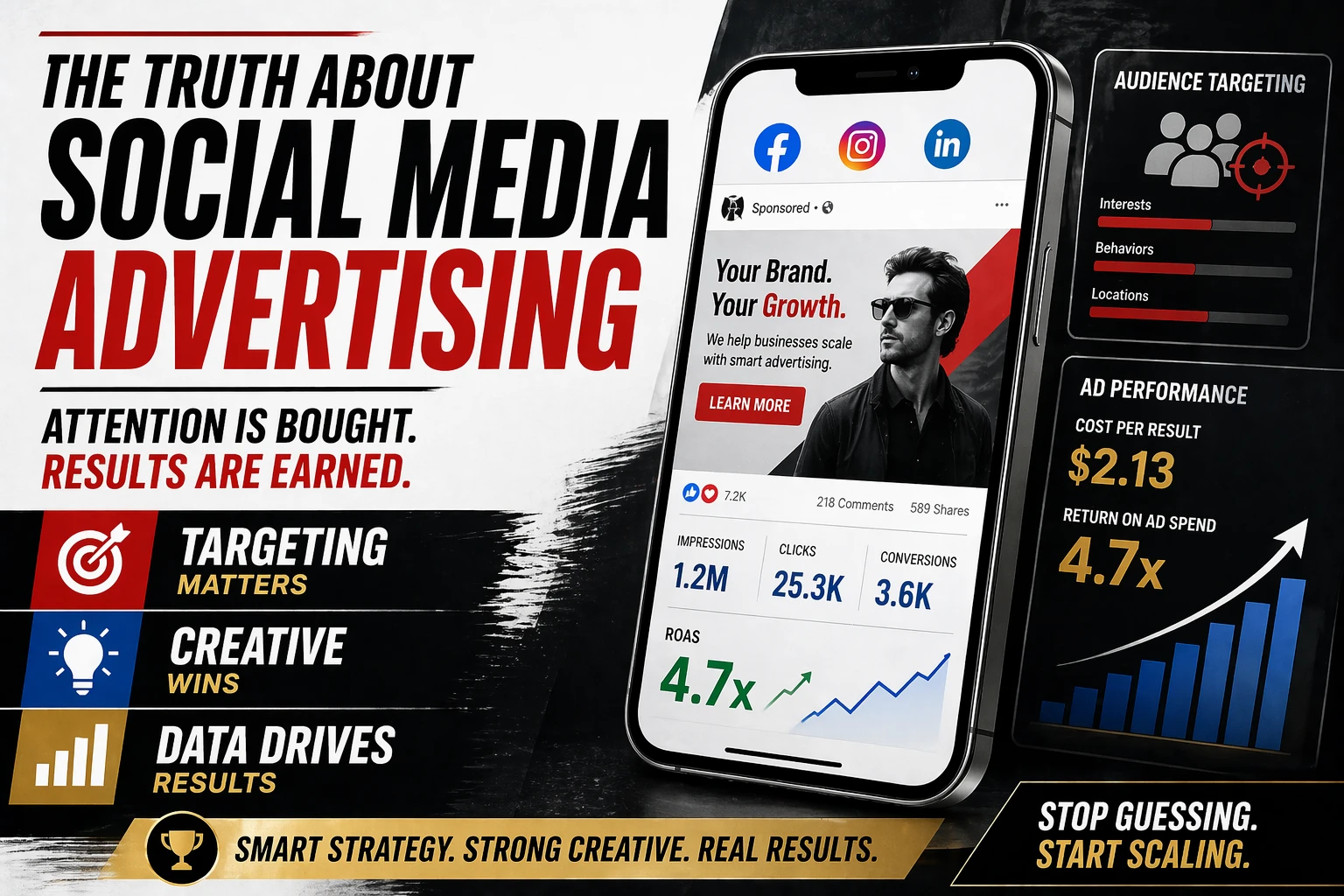
Social media advertising is simultaneously one of the most powerful business growth tools ever created and one of the most consistently misused. The platforms are incentivised to take your money and return just enough results to keep you spending. Most businesses hand over their budgets without a clear strategy, measure the wrong things, and conclude either that ads work brilliantly or that ads do not work at all, neither of which is usually true. Here is what the data actually shows.
The Platform Question: Where Should You Actually Be?
The first mistake most businesses make is choosing platforms based on where they personally spend time or where they have seen competitors advertising. The correct question is: where does my specific audience make decisions about the category I am in? The answers are different for almost every business, and confounding them is expensive.
- Facebook and Instagram: Still the broadest reach and most sophisticated targeting for consumer products and local services. The creative bar has risen significantly, static images barely function anymore. Video, Reels, and Story formats dominate.
- TikTok: Exceptional for brands targeting under 35 audiences with high entertainment value content. The CPM is still lower than Meta in most categories, but the creative requirements are high and the audience is ruthless about inauthenticity.
- LinkedIn: The only platform where B2B targeting by job title, seniority, company size, and industry is both possible and effective. CPCs are expensive ($8 to $15 in most B2B categories) but lead quality is typically the highest available in paid social.
- YouTube: The most underrated paid channel for complex or considered purchases. People watch YouTube to solve problems and learn, which puts them in exactly the right mindset for a well crafted informational ad that leads to a clear offer.
The Creative Problem Nobody Talks About
Ad performance on social platforms is primarily a creative problem, not a targeting or bidding problem. The algorithm's job is to find the right people for your ad, and it has become extraordinarily good at this, to the point where overly narrow audience targeting often underperforms broad targeting with excellent creative. What the algorithm cannot do is make bad creative perform. Boring ads, generic stock photography, and messaging that talks about the brand rather than the customer's problem are the leading causes of wasted social ad spend.
The creative that consistently outperforms in our client campaigns shares three characteristics: it stops the scroll in the first frame (with a pattern interrupt, a bold statement, or something visually unexpected), it speaks directly to the audience's specific pain or aspiration rather than the brand's features, and it has a single, clear next step that matches the audience's level of awareness and intent.
Social media ads do not fail because of targeting. They fail because the creative does not earn the attention of a person who was not looking for you, and nothing in the algorithm compensates for that.
The Funnel That Actually Works
The most common social ad mistake is sending cold audiences directly to a purchase or enquiry page and being surprised when they do not convert. Cold audiences (people who have never heard of your brand) convert at a fraction of the rate of warm audiences who have already interacted with your content or visited your website. An effective social ad funnel works in stages.
Top of funnel content (educational videos, useful posts, brand awareness creative) builds the audience of people who know who you are. Middle of funnel retargeting, shown to people who watched your video, visited your website, or engaged with your social content, converts that awareness into consideration. Bottom of funnel retargeting, shown to people who visited your pricing page, added to cart, or submitted a partial form, converts consideration into action. Skipping stages is why most direct response social ads disappoint.
What to Measure, and What to Ignore
Social platforms are exceptionally skilled at surfacing metrics that look impressive and do not correlate with revenue. Reach, impressions, likes, and profile visits are vanity metrics. The numbers that matter are cost per click, cost per lead or cost per acquisition, return on ad spend, and the quality of the leads generated, are they converting downstream into actual customers?
Set up proper conversion tracking before spending a single dollar. Every platform offers pixel or event tracking that allows you to see exactly which ad, which audience, and which creative led to a conversion. Without this, you are optimising in the dark, unable to distinguish the campaigns that are working from the ones draining budget.
Budget: How Much Should You Actually Spend?
The honest answer is: enough to generate statistically meaningful data from which you can optimise. For most businesses starting with paid social, that means a minimum of $1,500 to $3,000 per month, below which the data volume is too thin to make reliable decisions. Spreading $500 across four campaigns teaches you nothing. Concentrating $1,500 into one well built campaign with a clear hypothesis generates learnings you can build on.
Scale only what is working. The temptation to increase budgets on campaigns before they have proven themselves at a smaller scale is the fastest way to scale a loss. Identify a campaign that is generating leads or sales at an acceptable cost per acquisition, then increase its budget by 20 to 30% per week. Doubling a budget overnight almost always disrupts the algorithm's learning phase and degrades performance.
The Bottom Line
Social media advertising works when it is built on the right platform for the right audience, led by creative that earns attention rather than assuming it, structured as a funnel rather than a single shot at cold traffic, and measured on metrics that connect to actual revenue. When these elements are in place, paid social is one of the most scalable and predictable growth channels available. When they are not, it is one of the most reliable ways to burn budget without results.
Is Your Ad Budget Working Hard Enough?
We audit, rebuild, and manage paid social campaigns for businesses that want results they can measure. Let us review your account.
Get a Free Ad Account Audit →