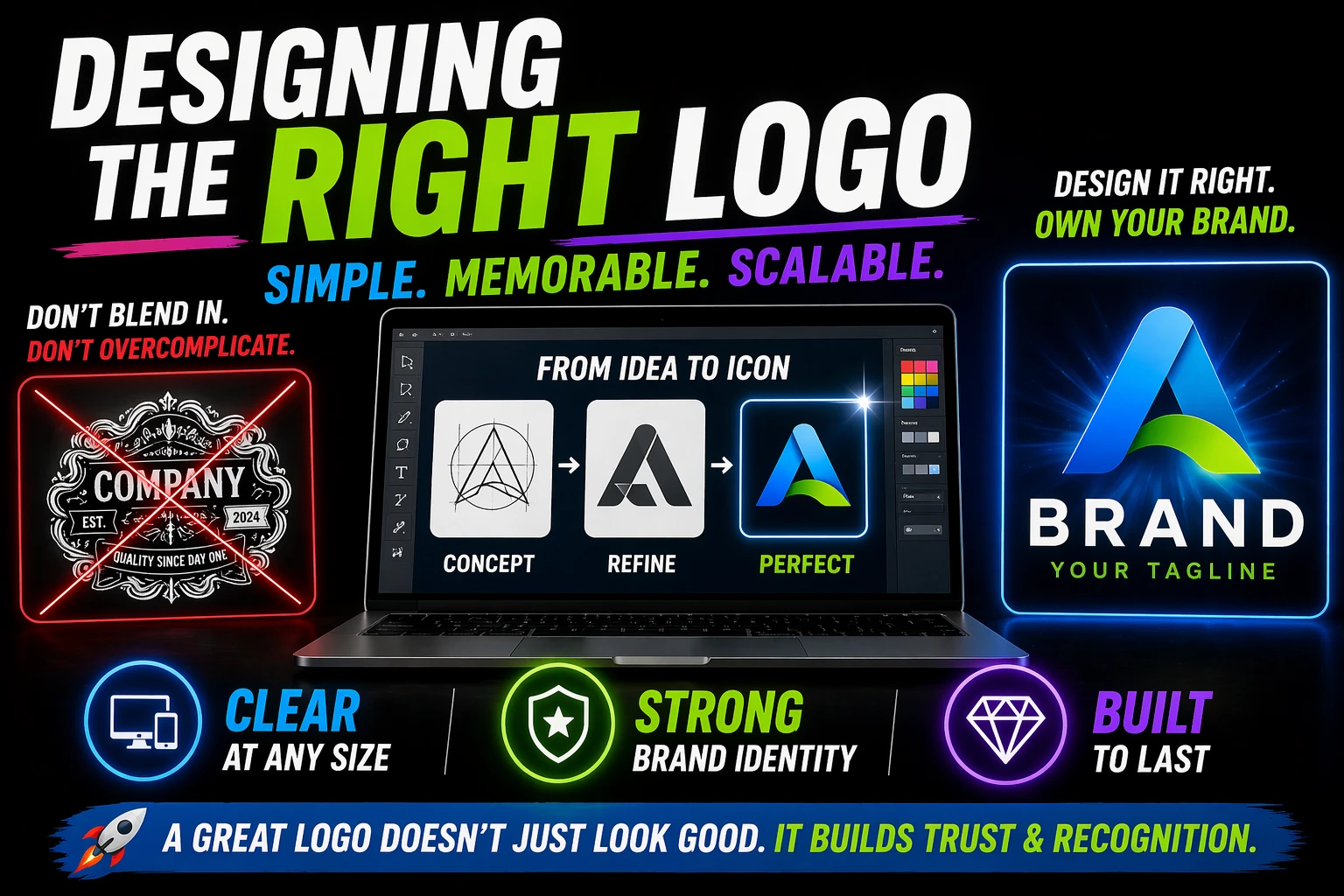
Most businesses get their logo wrong the first time. Not because the designer was bad or the brief was unclear, but because they approached it as a visual problem rather than a strategic one. A logo is not decoration. It is the single mark that will appear on every touchpoint your customer encounters: your website, your packaging, your social profiles, your email signature, your signage, your uniforms. Getting it right from the start is not optional. Getting it wrong is expensive to fix.
What a Logo Is Actually Supposed to Do
A logo has one job: to be instantly recognisable and to trigger the right feeling in the person who sees it. That is it. It does not need to show what you do. It does not need to contain your tagline. It does not need to incorporate every colour associated with your industry. The Nike swoosh does not look like a shoe. The Apple logo does not look like a computer. What both logos do is create an immediate, consistent, emotional association with the brand, and that is the standard to aim for.
The Five Principles of Effective Logo Design
Principle 1. Simplicity
The most enduring logos in the world are also among the simplest. Simple marks reproduce well at any size, from a 16px favicon to a 10 metre billboard. They are easy to remember after a single exposure. They work in one colour, which means they work on any background. Every element you add to a logo is an element that can work against these goals. The best brief you can give a designer is: make it simpler than you think it needs to be.
Principle 2. Relevance
A logo should feel appropriate for its category without being predictable within it. A legal firm's logo should feel authoritative and considered, but it does not need to show scales of justice. A children's education brand should feel warm and accessible, but it does not need primary colours and cartoon characters. Relevance means hitting the right emotional register, not illustrating the obvious.
Principle 3. Distinctiveness
Your logo needs to be distinguishable from every other logo in your competitive space. This is where most logo briefs go wrong: the client asks for something that looks like the industry leader, and ends up with a mark that reads as generic at best and imitative at worst. Distinctiveness requires actively studying what your competitors look like and deliberately choosing a different visual direction.
Principle 4. Versatility
A logo that only works in full colour, at large size, on a white background, is not a finished logo: it is a draft. Your final mark needs to work in solid black, solid white, and every size from app icon to billboard. Test it reversed out on dark backgrounds. Test it at 32 pixels. If it falls apart at small sizes or loses meaning when simplified to one colour, the design needs refinement.
Principle 5. Longevity
Logos should be designed to last at least a decade. Trend driven design ages visibly and creates the need for costly rebrands. The logos that have served brands best (think IBM, Coca-Cola, FedEx) have stayed fundamentally consistent for generations with only subtle refinements. Design for where your brand is going, not for what is fashionable in the current design cycle.
A great logo is not the most beautiful thing your designer has ever made. It is the most honest visual representation of what your brand stands for, distilled to its simplest possible form.
The Brief: Where Every Great Logo Starts
The quality of your logo is largely determined before the designer opens their software. A strong brief answers: What does the business do, and who does it serve? What feeling should the logo create, trust, excitement, calm, authority, playfulness? Who are your main competitors and what do their visual identities look like? Where will the logo primarily appear, digital, print, physical products, signage? Are there any hard constraints, colours to avoid, marks that could be confused with existing IP?
A brief that answers these questions gives a designer the strategic foundation to make meaningful creative decisions. A brief that says "make it modern and professional" produces generic output, because every designer has a different interpretation of those words.
Typography: The Most Overlooked Element
For many businesses, the logo is primarily a wordmark: the business name set in a distinctive typeface. This is often the strongest choice, particularly for service businesses and personal brands where the name itself is the equity. The typeface selection is as important as any graphic element: serif fonts communicate heritage and authority, sans serif communicates clarity and modernity, display typefaces communicate personality. Choose a typeface that reflects your brand's character, not simply the one that looks most impressive in the designer's portfolio.
Colours and What They Signal
Colour psychology in branding is real, but it is more nuanced than the standard charts suggest. Blue signals trust, which is why it dominates finance, tech, and healthcare. Green signals growth and health. Black signals premium and authority. But these associations only hold when the colour choice is consistent with everything else the brand does. A discount retailer in all black does not feel premium: it feels incongruous. Choose colours that feel true to your brand's actual positioning, not aspirational to a tier you have not yet earned.
When to Rebrand and When to Refine
Not every logo problem requires a full rebrand. If your mark has strong recognition but looks dated, a refinement (adjusting proportions, modernising the typeface, cleaning up the icon) often preserves the equity you have built while bringing the visual identity current. A full rebrand is warranted when the logo actively misrepresents what the business has become, when the business has pivoted significantly in positioning or audience, or when the existing mark has genuine technical limitations that cannot be resolved by refinement.
The Bottom Line
Your logo is not just a file in a folder. It is the visual anchor of everything your brand communicates. Approach the design process strategically, with a clear brief, competitive context, and an understanding of what you need the mark to do, and you will get a logo that serves you for years. Approach it as a vanity exercise and you will be back at the drawing board sooner than you think.
Ready to Build a Brand That Lasts?
Our design team creates visual identities built for recognition, longevity, and growth. Let us talk about yours.
Start Your Brand Project →