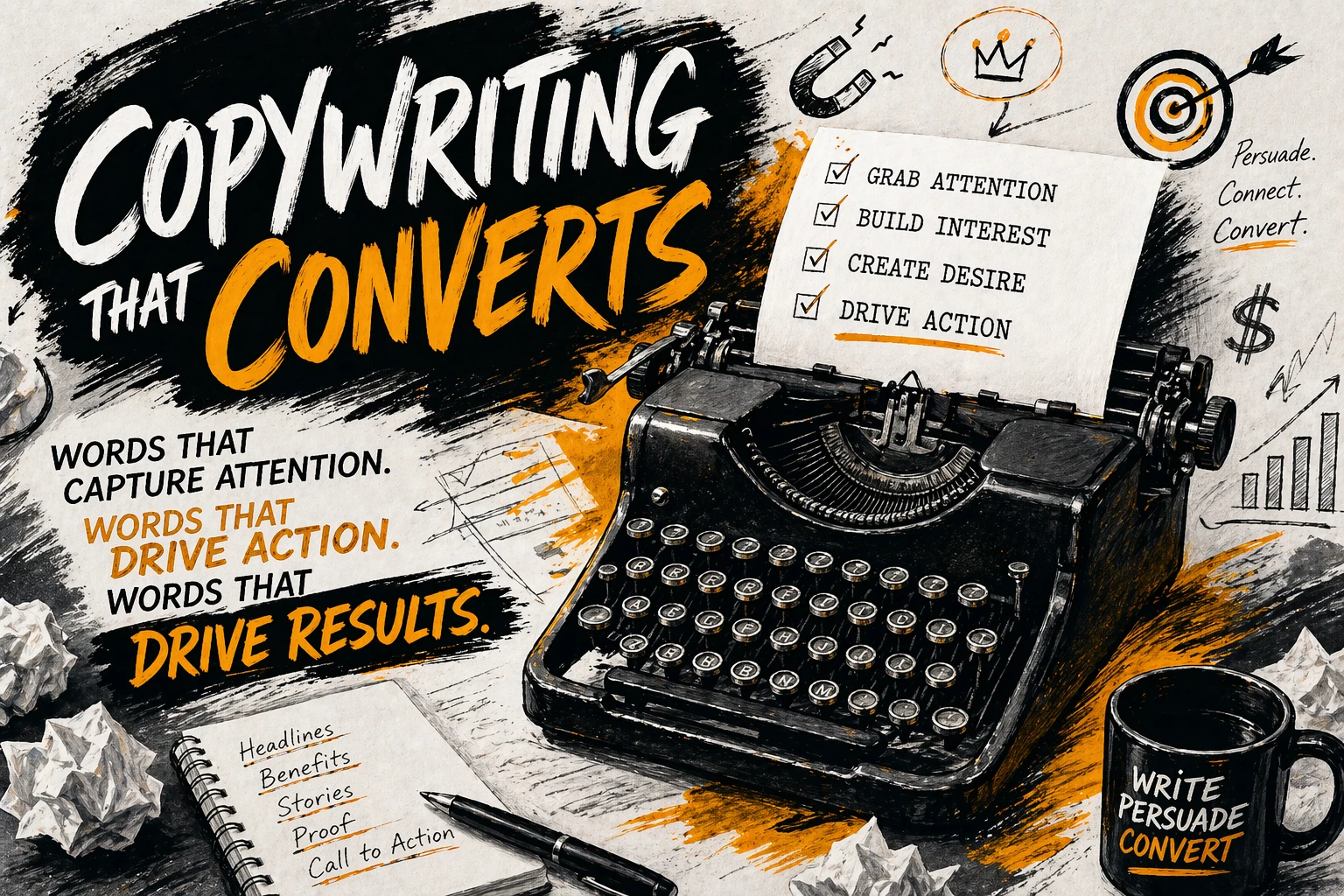
Most businesses spend more time designing their website than writing the words on it. This is exactly backwards. Design creates a first impression. Copy creates a decision. The words on your pages are the mechanism by which a curious visitor becomes a paying customer, and treating them as an afterthought is one of the most expensive mistakes a business can make.
Good copywriting is not about being clever or creative. It is about understanding your customer's situation so precisely that they feel understood when they read your words, and constructing a logical, emotional argument for why acting now is in their best interest.
The Psychology Behind Conversion Copy
Human beings make purchasing decisions primarily on emotion and justify them with logic after the fact. This is not a marketing theory. It is a documented finding from decades of behavioural economics research. The practical implication for copywriters is that the most effective copy addresses how a customer feels about their problem before it presents any solution.
The buying process follows a consistent pattern. First, awareness of a problem or desire. Then consideration of possible solutions. Then evaluation of specific providers. Then a decision, followed by justification to themselves and others. Copy that speaks to where the customer is in this process, rather than where the business wants them to be, converts at a significantly higher rate. A homepage that immediately pitches the product skips steps one and two, which is why it feels pushy rather than helpful to most visitors.
The PAS Framework: The Backbone of High-Converting Copy
PAS stands for Problem, Agitation, Solution. It is the most reliably effective structure for persuasive copy, from email subject lines to homepage hero sections to long-form sales pages. Understanding it is the single highest-leverage copywriting skill a business owner or marketer can develop.
Problem: Name the Pain with Precision
Start by describing the customer's problem in their own language, as specifically as possible. Not "your marketing is not working" but "you are spending money on ads every month and still struggling to generate consistent enquiries." The specificity signals understanding. Vague descriptions of problems feel generic. Specific descriptions feel like you have been watching over the customer's shoulder.
The best source for this language is your actual customers. The words they use in emails, in sales calls, in review sites, and in conversation are infinitely more persuasive than words written from inside your business looking out. If you are unsure what language to use, read your five-star reviews and your support tickets. Your customers have already written your copy for you.
Agitation: Make the Cost of Inaction Real
Once you have named the problem, the agitation step makes the reader feel the cost of not solving it. This is not about being manipulative. It is about helping the reader understand what is actually at stake if they continue with the status quo. How much is this problem costing them in time, money, or stress? What opportunities are they missing? What does the best version of their situation look like, and how far are they from it right now?
Agitation is the most commonly omitted step in business copy, which is why so much business copy fails to motivate action. Naming a problem is not enough. The reader needs to feel why solving it matters before they will take any action toward solving it.
Solution: Present Your Offer as the Logical Next Step
After problem and agitation have done their work, the solution step introduces your product or service as the natural resolution. Because the reader already feels the weight of the problem and understands what it is costing them, your solution does not need to work as hard. It simply needs to be credible, specific, and easy to act on.
Describe the outcome your customer gets, not the features of your service. Not "we offer a full digital marketing package including SEO, paid advertising, and social media management" but "you get a consistent flow of qualified leads and a clear picture of which marketing activities are generating them." The first describes what you do. The second describes what the customer experiences as a result.
The best copywriters are not wordsmiths. They are empathists. They understand the customer's situation so precisely that the words almost write themselves, because they are simply saying back to the customer what the customer already knows and feels.
Headlines: The Most Valuable Real Estate on Your Page
David Ogilvy, one of the most successful advertising practitioners of the twentieth century, argued that the headline is worth 80 cents of every dollar spent on copy. On a web page, this is if anything an understatement, given the speed at which visitors make decisions about whether to keep reading.
Effective headlines do at least one of four things: state a specific benefit ("Generate 3x more leads from your existing website traffic"), provoke curiosity ("Why your homepage is your worst-performing sales tool"), make a specific promise ("How to reduce your cost per lead by 40% in 90 days"), or address a fear or desire directly ("Stop losing customers to competitors with worse products but better websites"). The weakest headlines describe the business rather than speaking to the customer's experience. "Welcome to our website" and "About our services" are the two most common and least effective headlines on the internet.
Calls to Action: Removing the Friction From the Next Step
A call to action is not a button with the word "Submit" on it. It is a specific description of what happens when the visitor takes the next step, and why they should want to. "Get Your Free Website Audit" is more effective than "Contact Us" because it tells the visitor exactly what they receive and uses the word "free" to eliminate cost as an objection. "Book Your Strategy Call" is more effective than "Learn More" because it creates a specific, concrete image of the next step rather than a vague gesture toward more information.
Test your calls to action by asking: if someone reads only this button text and nothing else on the page, do they know what they are going to get and why they should want it? If the answer is no, rewrite the button text until the answer is yes.
The Role of Social Proof in Copy
Claims you make about yourself carry far less weight than claims made by others on your behalf. Weaving social proof directly into your copy, rather than relegating it to a separate testimonials section, dramatically increases the persuasive power of the surrounding text. Instead of "We are the leading digital marketing agency in the region" followed by a testimonials block, try "Clients like [Name at Company] have seen [specific result] after working with us" and place the specific testimonial quote directly adjacent to the claim it supports.
The most persuasive testimonials include: the customer's full name and company, a specific measurable result, a before-and-after contrast, and a statement about why they chose you over alternatives. Ask for these elements explicitly when requesting testimonials from clients. The specific version will always outperform the generic one.
Testing Your Copy
The most important thing to know about copywriting is that no one, including the most experienced professional copywriter, can reliably predict which version of a piece of copy will perform better before testing it. Split testing, also known as A/B testing, is the process of showing two versions of a page to equal portions of your traffic and measuring which produces better results. At minimum, test your homepage headline and your primary call to action. These two elements have the highest impact on conversion rate and are worth the investment in testing infrastructure to get right.
Your Copy Might Be the Reason Visitors Are Not Converting.
We write conversion-focused copy for websites, landing pages, and ads. Backed by split testing and grounded in your customers' actual language.
Improve Your Conversion Copy →