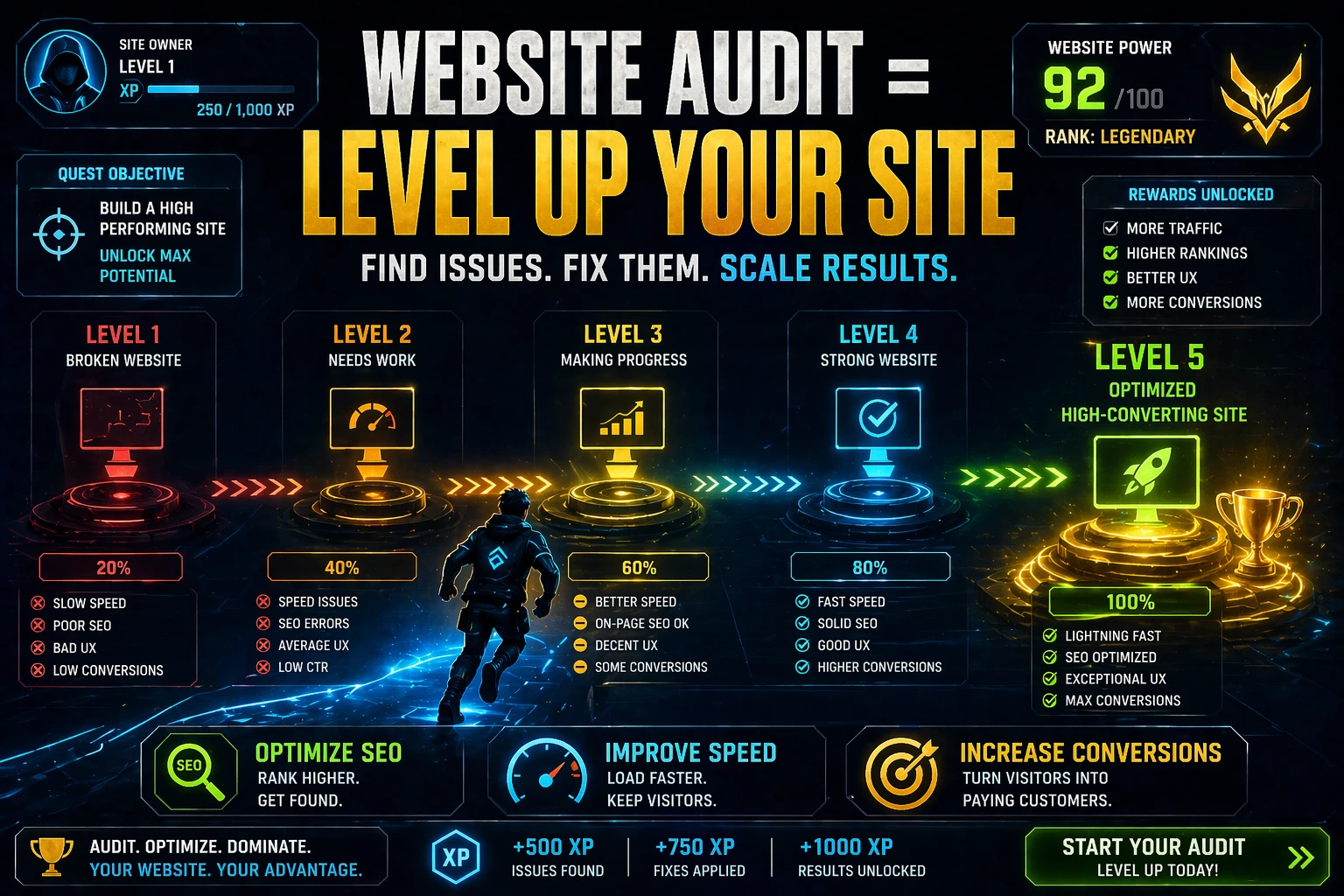
Before a new year begins, most businesses think about budgets, promotions, and fresh campaigns. Far fewer step back and examine the digital foundation those efforts will depend on. A year-end website audit is not about perfection — it is about making sure the platform is ready to support whatever comes next.
Start With First Impression Clarity
Open the homepage as if you know nothing about the business. Can you understand what the company does, who it serves, and what to do next within a few seconds? Ask someone outside the business to do the same and report back without coaching.
If the answer is not immediate and clear, that confusion is the most important thing to fix before the year turns. Every other marketing investment — ads, content, email — sends traffic to this page. If the page does not quickly establish relevance and direction, those investments are working with a handicap that compounds across every campaign.
Review Site Speed and Mobile Experience
Performance affects both visibility and conversion. A slow, awkward mobile experience weakens the effectiveness of almost every other marketing effort because it damages the first impression at the moment attention is highest.
Use Google PageSpeed Insights and Google Search Console's Core Web Vitals report to identify specific performance issues — not just a broad score, but the exact elements causing delays. On mobile, walk through the full journey from homepage to contact form with one hand on a real device. Friction that feels minor on desktop often becomes a genuine barrier on phone.
Check Core Service Pages
Service pages often become stale over time as the business evolves but the website does not. Review whether each page still reflects the current offer, current proof, and current positioning. Language written two or three years ago may no longer match how the business describes its work today — or how customers search for it.
Pages that attract organic traffic but produce few enquiries deserve particular attention. The disconnect between visits and action usually points to a trust, clarity, or relevance gap that a focused update can correct. Identify the top three service pages by traffic and review each one with fresh eyes.
Look at Trust and Proof
Review testimonials for recency — old reviews from years ago carry less weight than recent ones. Check case studies for accuracy and current relevance. Confirm that contact details, physical address if applicable, and team information are all up to date. Look for any outdated copyright years, expired offers, or references to the business as it no longer operates.
A strong audit treats trust as a practical commercial issue, not just a design preference. Every trust gap costs the business a percentage of the visitors who would otherwise have converted. Fixing those gaps is usually faster and cheaper than acquiring more traffic.
The website you carry into a new year should not be the same one you stopped questioning in the last.
Review SEO and Content Paths
Check whether important pages are properly indexed in Google Search Console. Review which pages are attracting organic traffic and whether they are internally linked to the service pages most relevant to that intent. Identify older articles that rank for valuable terms but have not been updated recently — these are refresh candidates.
A year-end content review often reveals pages that were built but never properly connected to the rest of the site. Orphaned pages that cannot be reached through normal navigation are not contributing to the site's overall authority signal and may be costing the business rankings they should have.
Audit the Conversion Journey
Test every form on the site to confirm it submits correctly and triggers the expected confirmation. Click every primary call-to-action button. Review thank-you pages to ensure they set appropriate next steps rather than leaving the visitor in a blank end state.
Small conversion path failures are common and costly. A form that appears to submit but does not send notification emails, a thank-you page that goes nowhere, or a CTA button that links to the wrong page — each of these quietly suppresses conversion rates without producing any visible error. Year-end is the right time to catch them all.
Turn Findings Into Priorities
The point of an audit is not to generate an overwhelming list of imperfections. It is to identify the changes most likely to improve performance in the next quarter and to create a clear, sequenced plan for addressing them.
Rank findings by impact and effort. High-impact, low-effort fixes — a broken form, an outdated homepage headline, a missing mobile CTA — should be addressed immediately. Higher-effort improvements — a full service page rewrite, a content cluster build, a new case study — can be scheduled into the first quarter. The audit creates the map. The plan creates the momentum.
Turning Insight Into Action
The strongest marketing articles become useful when they change the next decision. The goal is not just to understand the principle. It is to turn that principle into clearer priorities, better execution, and stronger results over time.
Need a Website Audit Before the New Year?
We review sites for conversion, visibility, trust, and messaging so the next quarter starts with a clearer digital foundation.
Audit My Website →