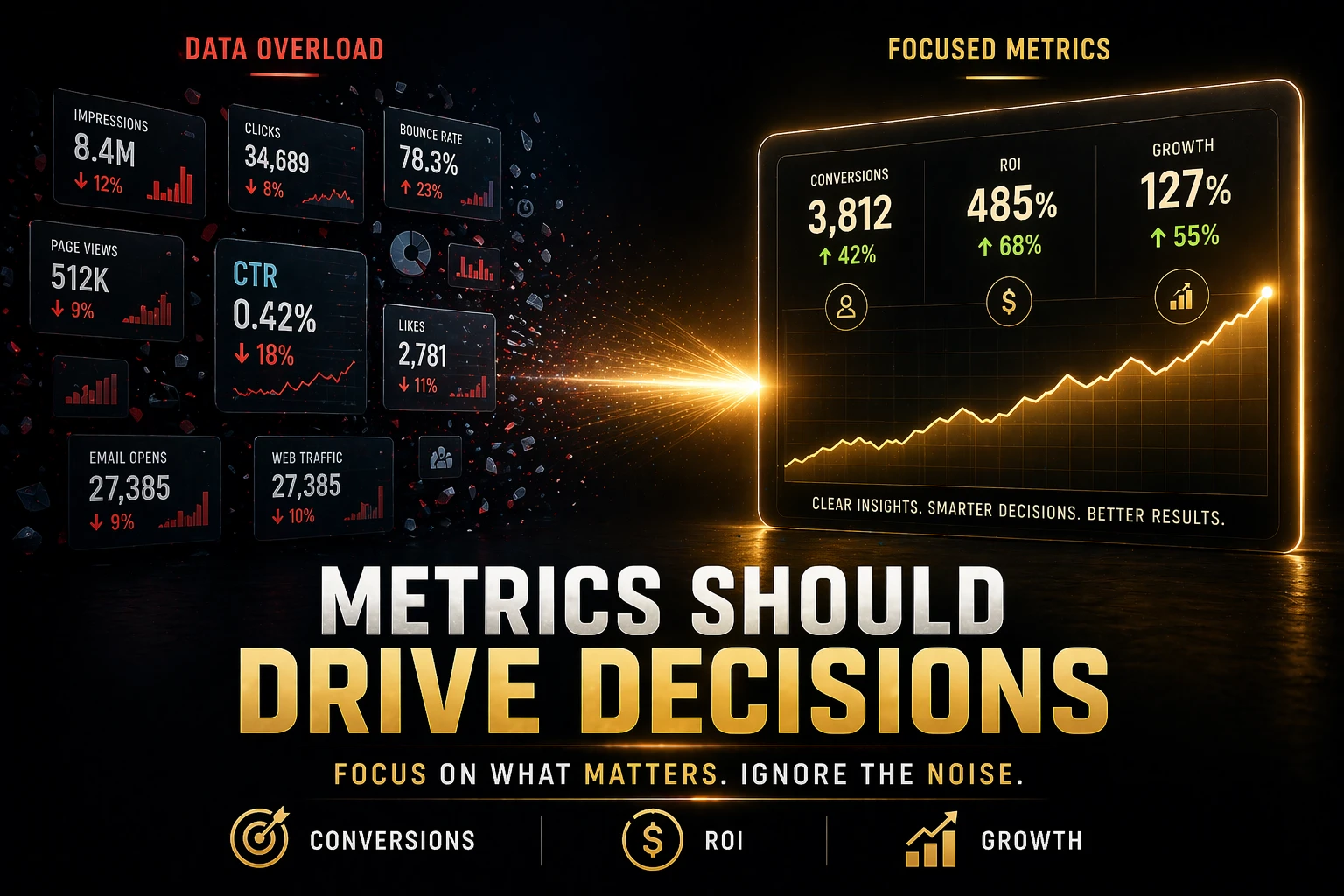
Modern marketing platforms make it easy to collect endless data. That does not mean endless data is useful. The real challenge — the one most businesses never fully solve — is knowing which numbers are important enough to change what you actually do next.
Why Too Much Data Can Be a Problem
When every dashboard is full, important signals get buried beside vanity metrics and context-free numbers. Marketing platforms are incentivised to show you more data, not better data. The default view is almost always wider than it needs to be — which means the work of finding signal inside noise falls to the business.
That can make reporting feel busy without making the business any smarter. Teams spend time building reports that no one acts on. Meetings discuss metrics that do not connect to decisions. The data is technically accurate but practically useless — and the business keeps making choices based on instinct rather than insight.
Start With the Business Objective
Metrics become useful when they are tied to a real goal: more qualified leads, better conversion rates, stronger retention, lower acquisition cost. Without that connection, numbers are easy to admire and hard to use.
The best place to start is the outcome the business cares about most right now. If the goal is to book more discovery calls, the relevant metrics are those that measure the path to a booked call — traffic to the contact page, form completion rate, call booking rate, and lead source. Everything else is context, not priority.
Traffic Is Only a Starting Point
Traffic can indicate reach and interest, but it says little on its own about business quality. A site receiving 50,000 visitors per month from unqualified sources is generating data but not value. A site receiving 2,000 highly targeted visitors that convert at 8 percent is doing something far more useful.
A smaller traffic source that converts well may be more valuable than a large one that does not. This seems obvious in principle but is frequently ignored in practice — because traffic numbers feel impressive in reports and are easy to optimise for in ways that inflate volume without improving quality.
Conversion Metrics Deserve Attention
Form completions, booked calls, purchases, and assisted conversions are often more meaningful than traffic or engagement figures because they show actual movement toward an outcome. These are the numbers that most directly answer the question every business is really asking: is the marketing working?
For service businesses, conversion data should be tracked at multiple stages — not just the final purchase but the micro-conversions along the way. A visitor who downloaded a guide, returned to the pricing page, and then submitted a contact form is telling you something valuable. Tracking only the final step loses most of that story.
The value of a metric is not that it exists. It is that it changes what you do next.
Channel Efficiency Matters
Cost per lead, quality of enquiries, and downstream conversion rates help reveal which channels deserve more investment and which are consuming budget without producing returns. Not every source needs to perform the same way, but each one should be able to justify its role in the overall mix.
Channel efficiency analysis often reveals surprises. A social media channel that looks busy but generates no qualified leads may be diverting budget from a search channel that converts at three times the rate. Without channel-level data tied to outcome metrics, these imbalances remain invisible and expensive.
Engagement Metrics Need Context
Open rates, click rates, time on page, and social engagement can all be useful when interpreted properly. They become misleading when treated as success without regard to business impact. A campaign with a 45 percent open rate that produced no leads is not a strong campaign — it is an interesting data point that needs more context.
Engagement metrics work best as diagnostic tools rather than success indicators. High engagement with low conversion suggests a relevance gap between the content and the offer. Low engagement with reasonable conversion might indicate an audience that acts quickly rather than deeply. Neither story is clear from engagement data alone.
The Best Reports Create Action
A strong marketing report should make priorities more obvious. It should help the team answer three questions: where should we improve, where should we stop, and where should we invest more. That is what useful measurement looks like — not a summary of what happened, but a guide to what to do next.
The most useful reporting habit is a simple weekly or monthly review of a small number of key metrics tied directly to business objectives. Not a 20-slide deck. A one-page summary that answers: how did the most important number move, why, and what changes as a result? That discipline — simple, consistent, action-oriented — is what separates businesses that learn from their data from those that merely collect it.
Turning Insight Into Action
The strongest marketing articles become useful when they change the next decision. The goal is not just to understand the principle. It is to turn that principle into clearer priorities, better execution, and stronger results over time.
Need Cleaner Reporting?
We help businesses focus on the numbers that guide channel decisions, conversion improvements, and smarter growth planning.
Improve My Reporting →