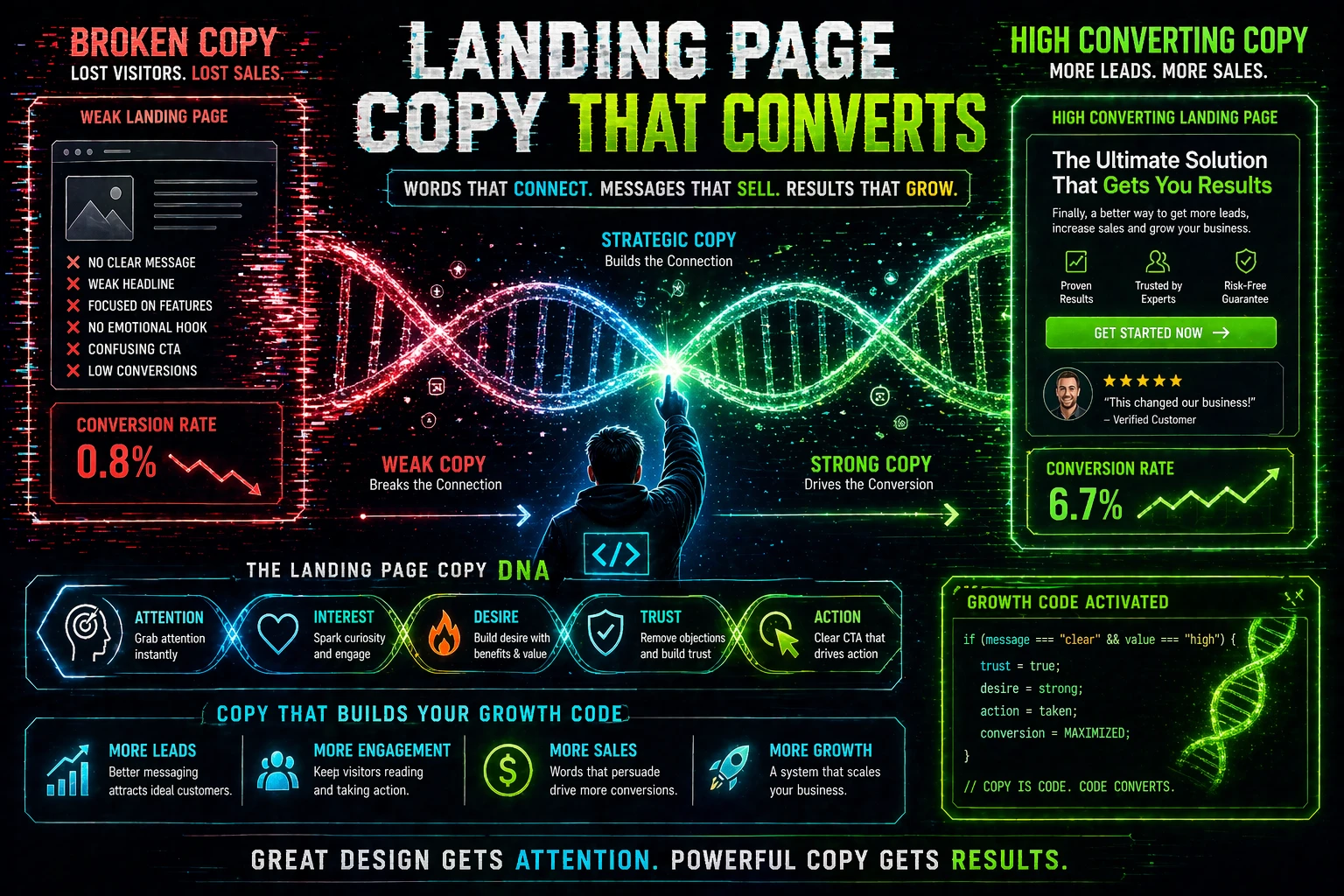
Good landing page copy does not feel like a performance. It feels like the page understands the visitor, respects their time, and makes the next step easier to justify. Most underperforming pages fail not because of bad products or poor design — they fail because the copy does not meet the visitor where they actually are.
Start With the Visitor Problem
The strongest pages enter the conversation already happening in the reader's mind. They speak to the friction, urgency, or desired outcome the visitor likely arrived with — not the features the business is most proud of. This does not require dramatic emotional language. It requires relevance.
The fastest way to improve a landing page is to stop leading with what you do and start leading with the situation the visitor is already in. A financial services page that opens with 'confused about what to do with your savings?' creates more connection than one that opens with 'industry-leading financial solutions since 2009.' One is about the visitor. The other is about the company.
Make the Offer Easy to Grasp
Visitors should understand what the business does, who it is for, and what happens next — without effort. When a page uses broad, abstract language, the visitor has to decode the value. That decoding takes energy, and most people are not willing to spend it.
Test this with someone unfamiliar with the business. Ask them to read the first screen and explain back what the company does. If they hesitate or get it wrong, the copy is doing too little work. Clarity here is not about dumbing down — it is about respecting the cognitive load a visitor arrives with and making the answer as easy to find as possible.
Headlines Need Direction
A strong headline sets context. A useful subheading adds precision. Together, they should reduce uncertainty rather than increase it. The goal is not to be clever enough to stand out. The goal is to be clear enough to move forward.
Many landing page headlines try to do too much — evoke emotion, state a benefit, include a keyword, and sound original all at once. That creates noise. The most effective headlines tend to do one thing well: they tell the visitor exactly what awaits them and make it feel worth continuing. A subheading can carry the nuance. The headline should carry the direction.
Specificity Builds Confidence
Specific language tends to outperform generic promises. Examples, proof points, deliverables, and concrete benefits help the page feel grounded. 'We help businesses grow' is not a claim — it is a placeholder. 'We help B2B service companies reduce their sales cycle from 90 to 45 days' is a statement that can be believed or challenged, which means it can also be trusted.
That specificity also gives the visitor something to evaluate. It moves the conversation from 'do I trust this business?' to 'does this result match what I need?' — which is a much more productive place for a buying decision to be made.
A landing page does not need to sound impressive first. It needs to be understood first.
The Call to Action Should Match Readiness
Some visitors are ready to buy. Others are only ready to learn more. A landing page works better when its calls to action respect those different levels of intent. That may mean combining a primary action — a call booking or purchase — with softer next steps like reviewing work samples, reading testimonials, or understanding how pricing is structured.
CTA copy matters more than most businesses realise. 'Submit' tells the visitor nothing about what they are submitting to. 'Get my free audit' or 'See how it works' names the value of the action rather than just describing the mechanism. When the CTA language aligns with where the visitor is in their decision, click rates improve.
Reduce Friction in the Middle of the Page
Many pages lose momentum after the hero section. The copy becomes repetitive or too general, and the visitor loses the thread of why they are still reading. The middle of the page is where objections live — and where they should be answered.
Use the body of the page to address the specific concerns that prevent action. What does the process look like? Who else has used this? What happens after I click? What if it does not work? These questions are not obstacles — they are the natural due diligence of a careful buyer. A page that answers them proactively converts more reliably than one that leaves them to linger.
Edit With the Reader in Mind
The final test for any landing page is simple. Does the copy sound like it is trying to help someone decide, or does it sound like it is trying too hard to sell them? That difference matters more than many businesses expect — because readers can feel the difference even when they cannot articulate it.
Strong landing page copy leaves the reader feeling oriented, respected, and clear on what to do next. Weak copy leaves them feeling sold to, uncertain, or vaguely skeptical. Editing with the reader in mind means cutting anything that serves the business's ego rather than the visitor's decision — and replacing it with language that earns the next click.
Turning Insight Into Action
The strongest marketing articles become useful when they change the next decision. The goal is not just to understand the principle. It is to turn that principle into clearer priorities, better execution, and stronger results over time.
Need Better Page Messaging?
We write and refine landing page copy that is clearer, sharper, and more persuasive without sounding forced or inflated.
Sharpen My Copy →