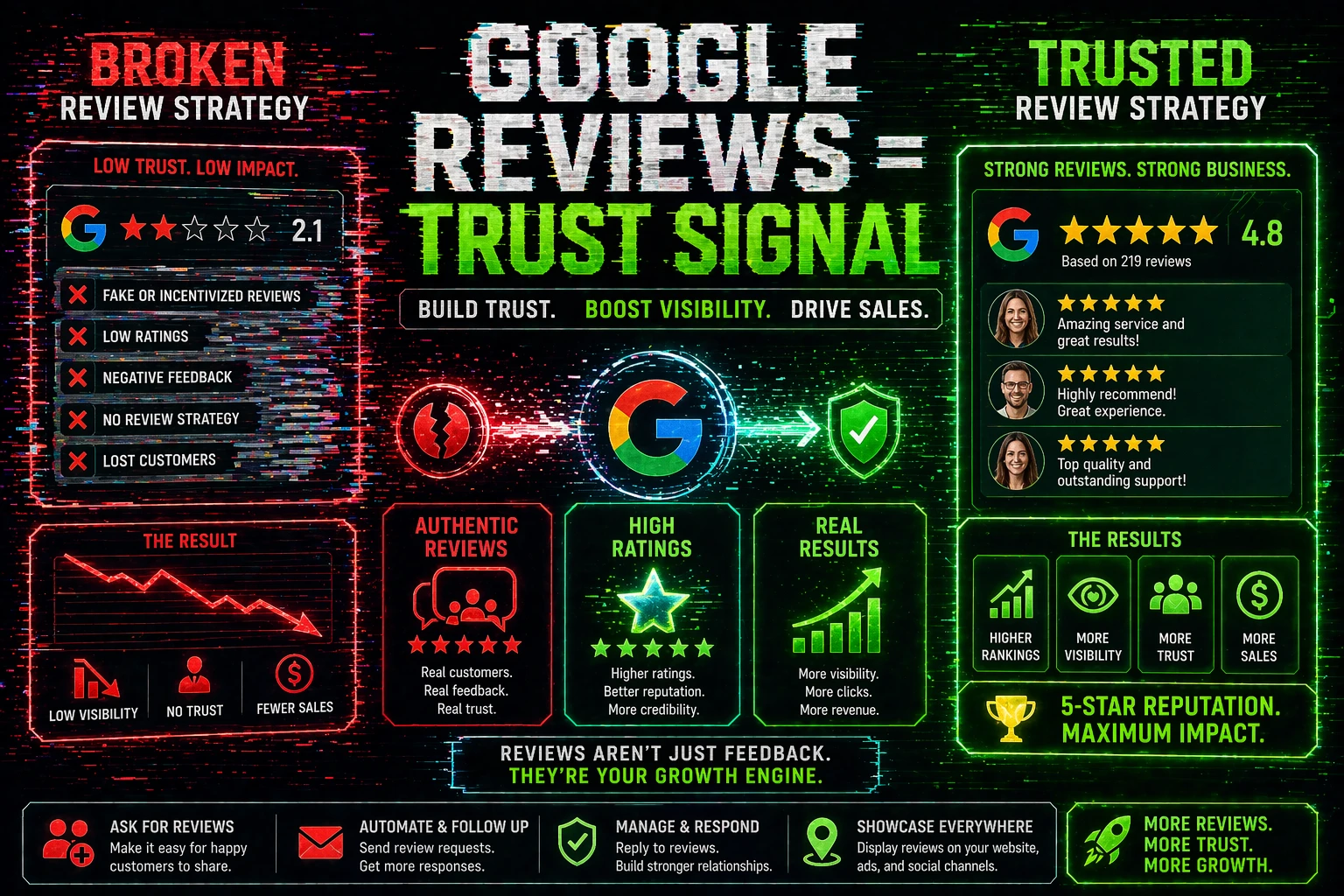
Google reviews are one of the strongest local trust signals a business can build, yet many companies still rely on occasional, inconsistent requests and then wonder why their review count stays flat. The problem is rarely a lack of satisfied customers. It is almost always a lack of system.
Why Reviews Matter So Much
Reviews affect local perception before the customer clicks anything else. They influence Google rankings, profile action rates, and conversion confidence on the website itself. A business with strong review depth often looks safer and more established even when the underlying service quality is similar to a competitor with fewer reviews.
Beyond rankings, reviews shape the emotional response of the next prospect. Seeing dozens of specific, recent experiences from real customers creates a form of social certainty that no amount of branded copy can replicate. The gap between a 12-review profile and a 120-review profile is not just cosmetic — it is a measurable difference in buyer confidence.
Timing Matters More Than Scripts
The best time to ask for a review is soon after a positive experience, when the customer still remembers the value clearly. Waiting a week lowers response rates because the emotional resonance of the experience has faded. Waiting a month makes the request feel disconnected and generic.
Timing is more important than the exact wording of the ask. A simple, direct request sent within 24 hours of a completed job or successful interaction will outperform an elaborate review campaign sent weeks later. Build the ask into the natural end of the customer experience, not as an afterthought once the moment has passed.
Make the Request Simple
A good review request is direct, polite, and easy to complete. Customers should not need to search for the profile or guess what you want from them. The fewer steps involved, the more likely the action gets completed. That means providing a direct link to the review form — not just asking them to 'find us on Google.'
SMS requests with a direct link consistently outperform email requests for local service businesses. If email is the primary channel, the link should be prominent, the instructions should be minimal, and the tone should be personal rather than corporate. Complexity is the enemy of completion.
Personalise Without Overcomplicating
Even a short message can feel more genuine when it references the specific experience and sounds like a real person wrote it. Review requests that feel copied and automated often get ignored — not because the customer is unwilling, but because the message does not feel like it deserves a response.
Personalisation does not require lengthy customisation. Mentioning the service type, the project, or the customer's name is usually enough to shift the feel from templated to thoughtful. That small shift in tone is often the difference between a request that gets opened and one that gets deleted.
Most businesses do not need more customers willing to leave reviews. They need a better moment and a better method to ask.
Do Not Chase Perfect Reviews
A healthy review profile usually contains a range of voices. The goal is not to pressure customers into saying something specific or to screen for only five-star experiences before asking. That approach feels manipulative, can violate platform policies, and tends to produce reviews that read as rehearsed.
The goal is to make it easier for genuinely satisfied customers to share their honest experience. When businesses ask at the right moment, with the right framing, from real interactions, the reviews that result tend to be specific and credible — which is far more persuasive than a wall of identical five-star ratings.
Responding Is Part of the Strategy
Review collection does not end when a review appears. Thoughtful responses to both positive and negative reviews show attentiveness and help future customers interpret the business positively. A response to a critical review that is calm, specific, and solution-oriented often builds more trust than the negative review costs.
Google also factors owner response activity into local search signals. An active, engaged profile tends to perform better than a passive one. Responding to reviews within a few days keeps the profile current and demonstrates that the business is paying attention — which matters to prospects who are still deciding.
Build It Into the Process
The easiest review system to maintain is the one built into normal business operations. If the ask only happens when someone remembers, results stay inconsistent. A process — even a simple one — always outperforms good intentions at scale.
This might mean triggering a review request automatically via CRM after a project closes, including a review link in every invoice or follow-up email, or briefing front-line staff on when and how to ask in person. The exact method matters less than the consistency. Businesses that treat review collection as an operational habit rather than an occasional campaign will always outgrow those that do not.
Turning Insight Into Action
The strongest marketing articles become useful when they change the next decision. The goal is not just to understand the principle. It is to turn that principle into clearer priorities, better execution, and stronger results over time.
Want a Better Review Collection System?
We help businesses build cleaner follow-up requests, stronger profile presentation, and review processes that feel natural for real customers.
Improve My Review Flow →