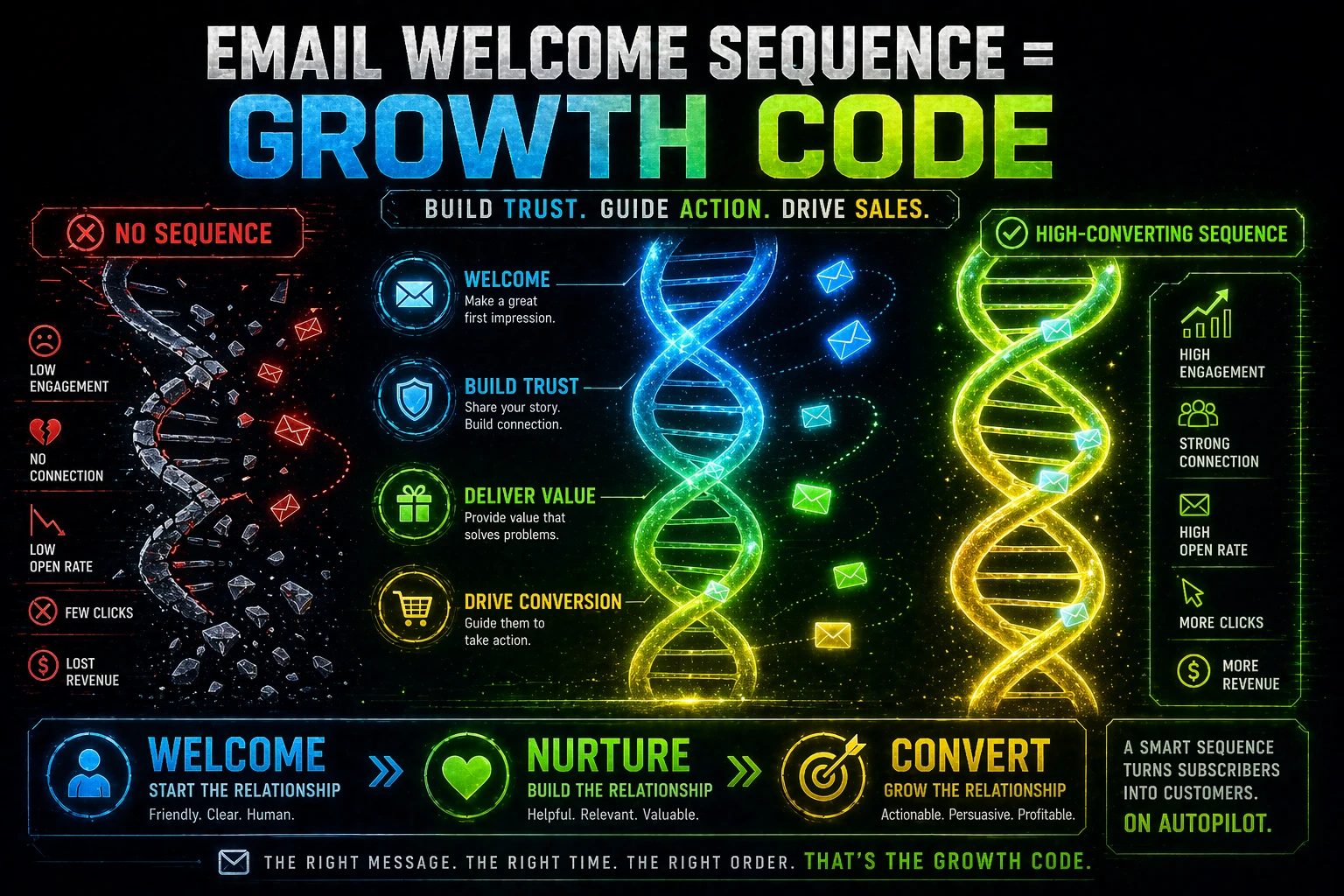
Many businesses put significant effort into collecting email addresses and then do very little with the moment immediately after signup. That is a costly oversight. Early attention is usually the easiest attention to earn — and how a business uses it determines whether that new subscriber ever becomes a buyer.
What a Welcome Sequence Does
A welcome sequence is a short series of emails sent after someone joins your list. Its job is to introduce the brand, clarify the value the subscriber signed up for, and guide them toward a useful next step. This is not just about saying thank you — it is about shaping expectations and building the foundation of a relationship that email marketing will depend on for months or years.
Done well, a welcome sequence transforms a cold name on a list into a warm, informed prospect who understands what the business does and why it matters. Done poorly — or not at all — it leaves a gap where momentum should be.
Why the First Few Emails Matter
New subscribers are often more engaged than long-term inactive ones. They just made a decision. They opted in because something was relevant to them right now — and that relevance window is narrow. The data consistently shows that email engagement drops over time if early contact is absent or weak.
That brief window of high attention can be used to educate, reassure, and move the subscriber closer to action. A business that spends weeks planning a monthly newsletter but ignores the first 72 hours after signup is optimising the wrong end of the relationship.
It Helps the Brand Feel More Human
A thoughtful welcome sequence helps people understand who you are, what you do well, and how you think. That is especially valuable for service businesses where trust must precede the purchase. A sequence that reads like a real person wrote it — with specific language, a clear point of view, and genuine usefulness — builds more trust than five polished promotional emails sent later.
This is also an opportunity to differentiate. Most businesses sound similar in their marketing. A welcome sequence that shows personality, shares a genuine story, or delivers unexpected value creates an impression that promotional emails rarely can.
You Can Answer Common Questions Early
Many sales objections appear repeatedly across all buyer conversations. A welcome sequence gives the business a chance to address those objections before they become reasons to hesitate. If prospects always wonder about pricing, process, or results, those questions can be answered proactively — making future buying decisions easier for the subscriber and more efficient for the sales process.
Think of it as a pre-sales conversation that happens automatically. Every question answered in the sequence is a conversation the team does not need to have manually — and a doubt that does not linger long enough to derail a decision.
When a new lead hears nothing after signing up, momentum disappears. The welcome sequence is what keeps it alive.
It Creates Better Traffic Later
When subscribers are introduced properly, later campaigns tend to perform better because the audience understands the brand more clearly. A subscriber who received a well-structured welcome sequence knows what to expect, why it matters, and what to do when the right offer appears. That context makes promotional emails land differently.
Stronger early framing improves the value of the whole list over time. Businesses that invest in a good welcome sequence often find that their overall open rates, click rates, and conversion rates improve — not just in the sequence itself but across their entire email program.
What to Include
A strong sequence often includes a welcome that delivers on the signup promise, a positioning email that explains what the business does and for whom, proof or examples that demonstrate results, a useful insight or resource that adds genuine value, and a clear invitation to take the next step — whether that is booking a call, visiting a key page, or replying with a question.
The exact format depends on the business model, but the principle stays the same: each email should earn the next open. If an email does not add value, create clarity, or build trust, it is not doing the job the sequence needs it to do.
Why Consistency Wins
Even a simple, well-written sequence is usually more effective than having nothing. Perfectionism is the enemy of progress here. A three-email sequence that introduces the brand clearly, delivers one useful insight, and makes one clean offer will outperform a planned ten-part sequence that never gets built.
The point is to create continuity between signup and sale. Subscribers who receive consistent, relevant communication in the early stages of the relationship convert at higher rates and remain subscribed longer. The welcome sequence is the beginning of that consistency — and consistency is what email marketing is built on.
Turning Insight Into Action
The strongest marketing articles become useful when they change the next decision. The goal is not just to understand the principle. It is to turn that principle into clearer priorities, better execution, and stronger results over time.
Need an Email System That Starts Strong?
We build welcome sequences that introduce the brand properly, strengthen trust, and turn sign-ups into better qualified buyers.
Build My Sequence →