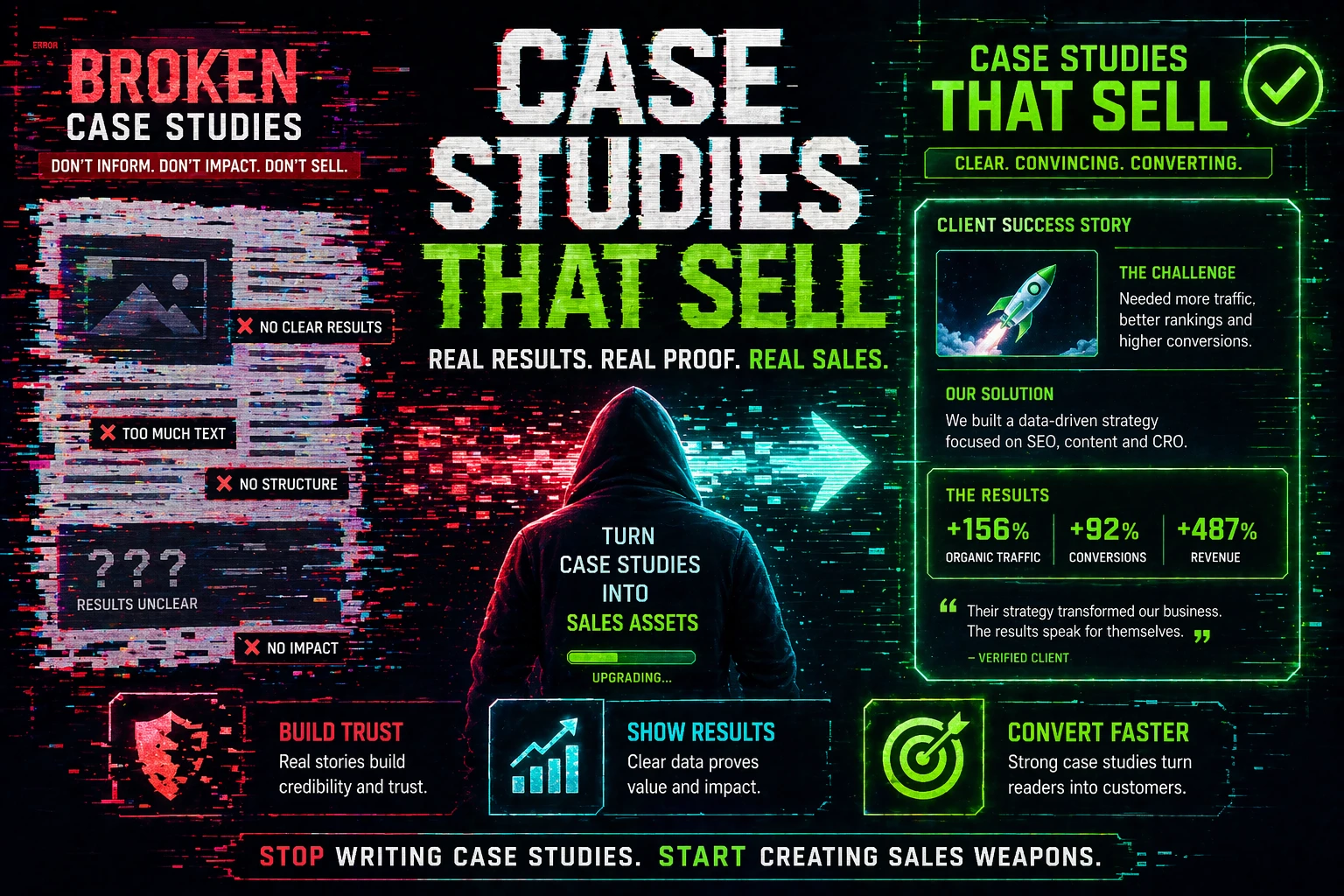
Marketing becomes easier to believe when it shows what happened for a real client. That is why case studies remain one of the most useful tools in a service business content strategy. While claims and promises fill most marketing pages, proof is what actually moves cautious buyers forward.
Why Case Studies Matter
A case study helps the reader see how your business thinks, works, and solves problems. It creates a more grounded form of credibility than broad promotional language alone. Anyone can claim expertise. Fewer businesses can demonstrate it clearly through a documented client outcome.
This distinction matters especially in service businesses, where the product is invisible until after the sale. A potential client cannot test a consulting engagement the way they might test a piece of software. Case studies bridge that gap by giving them a preview of what working with you actually produces.
They Reduce Uncertainty
Potential customers often wonder whether the service has worked for businesses like theirs. A relevant case study begins to answer that question before they even ask it. It also makes the buying risk feel lower — because if it worked for someone similar, it is more likely to work for them.
Uncertainty is one of the most common reasons qualified prospects stall. They are interested, but they hesitate. A case study that closely mirrors their situation — their industry, their problem, their size — is one of the most direct ways to dissolve that hesitation and make the next step feel safer.
A Good Case Study Needs Structure
The strongest format is usually simple. Start with the problem, then the context, then the actions taken, and finally the result or outcome. This helps the reader follow the logic rather than skim disconnected details.
Avoid starting with your company. Start with the client's situation. Buyers are looking for a mirror, not a brochure. The more the story feels like the client's journey — not your portfolio highlight — the more it will resonate with the prospect reading it. Keep the structure tight: problem, approach, result, and what made it work.
Specificity Makes the Story Stronger
Concrete situations, decisions, and observations make the work feel more believable. Even when exact revenue figures are not appropriate to share, the story can still be specific about process and impact. Phrases like 'significantly improved' signal nothing. 'Reduced response time from four days to under six hours' creates a picture.
Specificity also signals honesty. Vague outcomes sound polished but read as unverifiable. Specific ones — even when modest — feel real. A case study that describes the exact challenge a team faced, the decision that was made, and the measurable result it produced will outperform a glossy summary every time.
Case studies work because they turn claims into evidence — and evidence is what a hesitant buyer actually needs.
Use Them Across the Funnel
Case studies do not belong only on one hidden page. They can support proposals, sales conversations, social posts, landing pages, and email nurturing. That wider use increases the return on the effort required to create them.
In a proposal, a relevant case study becomes a third-party endorsement of your methodology. In a sales call, it becomes an anchor story. In a newsletter, it becomes proof that the advice you give actually produces results. A single well-crafted case study can serve a dozen different roles without feeling repetitive.
Choose Relevant Examples
The most useful case study is not always the biggest win. It is often the one that looks most similar to the buyer you want to attract. Relevance helps the prospect imagine themselves in the story — and imagination is the first step toward commitment.
Segment case studies by industry, problem type, or company size if possible. A small business owner scanning for proof does not identify with a case study featuring a national enterprise. The closer the match, the stronger the pull. It is better to have five highly relevant examples than twenty impressive but unrelatable ones.
Believability Is a Competitive Advantage
Many businesses sound similar in their marketing. Strong proof helps break that pattern. When people can see the work more clearly — the challenge, the approach, the outcome — they hesitate less and trust more quickly.
In competitive categories where every provider makes the same claims, the business with the best evidence wins more often than the one with the best rhetoric. Investing in a library of strong case studies is not just a content strategy. It is a positioning strategy that compounds over time as more evidence accumulates.
Turning Insight Into Action
The strongest marketing articles become useful when they change the next decision. The goal is not just to understand the principle. It is to turn that principle into clearer priorities, better execution, and stronger results over time.
Need Better Proof on Your Website?
We help businesses shape real client work into case studies that support trust, positioning, and higher conversion.
Build My Proof →