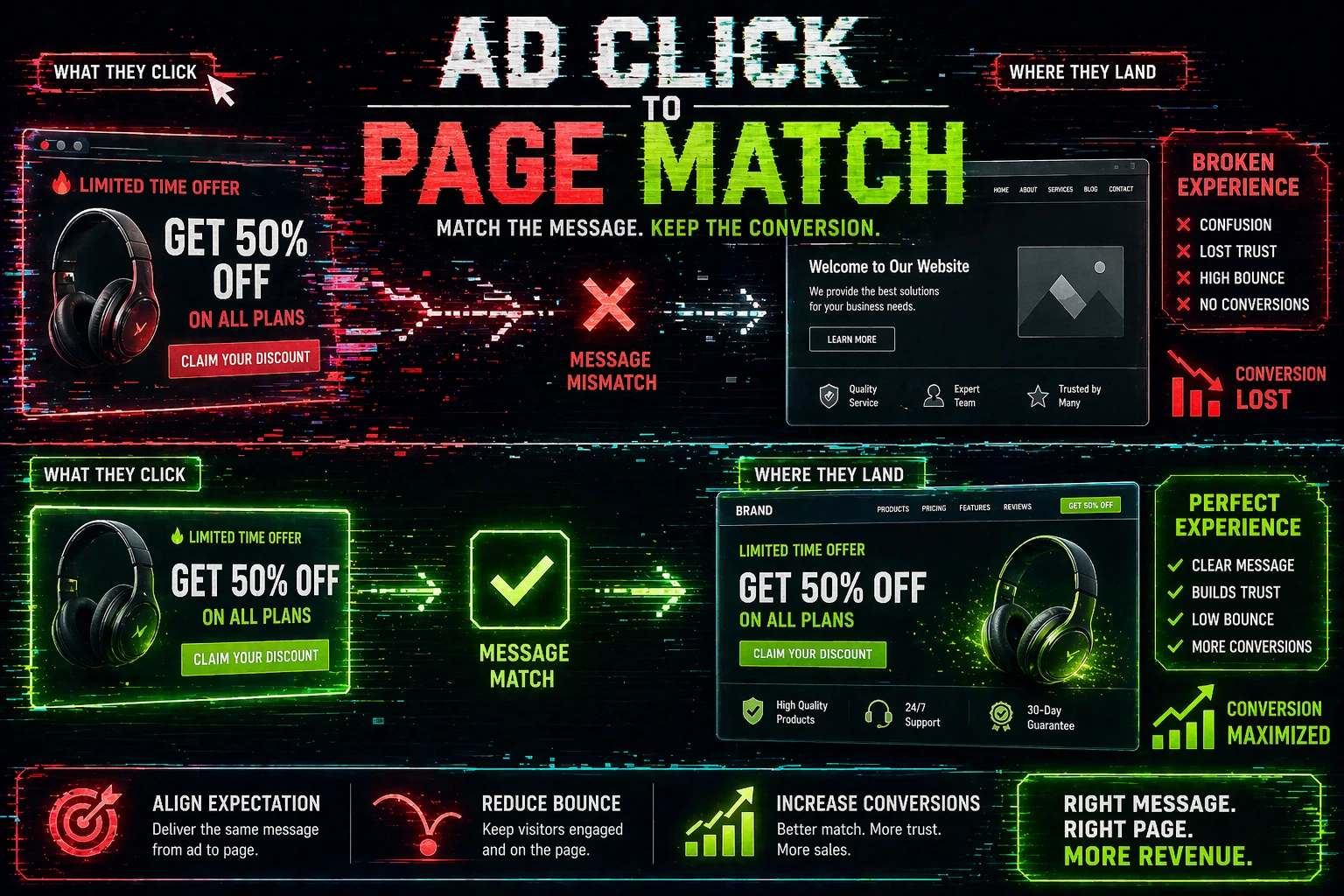
Paid ads often get blamed when campaigns underperform, but many failures begin after the click. The visitor lands on a page that feels disconnected from the promise that made them click in the first place. Understanding why this gap exists — and how to close it — is one of the highest-leverage improvements a paid campaign can make.
Why Message Match Matters
When a person clicks an ad, they carry an expectation onto the page. The headline, offer, and framing should feel like a continuation, not a reset. Research from Nielsen Norman Group confirms that users decide within seconds whether a page is relevant. If the connection to the ad is not immediately obvious, the visitor reassesses — and often leaves.
Message match is not just about repeating the same words. It is about preserving the emotional and logical momentum the ad created. If an ad promises a fast result, the page should lead with speed. If the ad highlights a specific offer, that offer should be front and centre, not buried below three sections of brand backstory.
Mismatched Pages Create Friction
Even a strong page can underperform if it does not reflect the ad properly. Visitors want reassurance that they arrived in the right place. That reassurance needs to happen within the first few seconds — before the page even finishes loading in their mind.
Common mismatches include sending traffic from a product-specific ad to a generic homepage, using different tone in the ad versus the landing copy, or featuring an offer in the ad that is not visible above the fold. Each disconnect adds friction that compounds across thousands of visits and quietly drains return on ad spend.
Offer Consistency Is Essential
If the ad promotes a specific service, bundle, or benefit, the landing page should lead with that same idea. Forcing the visitor to search for the connection wastes attention and weakens intent. The brain registers inconsistency as a risk signal, and risk slows decisions.
This applies to seasonal and promotional campaigns too. If a sale ad sends users to a page with full pricing, the disconnect is jarring. Dedicated campaign pages — even simple ones — almost always outperform general pages for paid traffic because they honour the promise that earned the click.
Design Can Also Break the Experience
A cluttered page, confusing layout, or slow mobile load can make the post-click experience feel less credible than the ad that brought the user there. Paid campaigns amplify these weaknesses because they expose them to more people faster.
Page speed matters more than most businesses realise. Google's research suggests that as page load time increases from one to three seconds, the probability of bounce increases by 32 percent. A beautifully crafted ad driving to a slow, poorly structured page is money left on the table. Design should clear the path to conversion, not create new obstacles.
A paid click is not a win until the page continues the conversation the ad started.
The Best Landing Pages Narrow Focus
Dedicated pages often convert better because they remove distractions and stay aligned to one objective. A generic homepage may be too broad for traffic that clicked a specific promise. Navigation menus, unrelated offers, and competing calls to action all pull attention away from the intended action.
The principle here is constraint as a feature. When a page has one clear job — to continue what the ad started and guide the visitor to one next step — it performs that job better. This is why dedicated landing pages for paid campaigns consistently outperform shared pages, even when the shared page is otherwise excellent.
Testing Should Include the Page
Businesses often test audiences, creatives, and bids while barely reviewing the landing experience. That leaves a major part of the funnel untouched. A/B testing ad creative is standard practice, but running those same experiments on page headlines, hero images, and primary CTAs is where many campaigns find their biggest gains.
Start simple. Test two versions of your headline — one that mirrors the ad, one that reframes it slightly. Measure completion rates, not just visits. The data usually reveals that small page changes outpace expensive creative refreshes when message match has been weak.
Paid Efficiency Depends on the Whole Path
A strong paid strategy is not just targeting. It is targeting plus a relevant page plus a clear next step. That full path is where conversion gets earned. The click is the beginning of a handoff, and a good handoff requires both sides of the exchange to be aligned.
When ad teams and web teams work in silos, message match suffers by default. The most efficient paid campaigns treat the ad and the landing page as a single unit — written together, tested together, and optimised together. That integrated approach is what separates campaigns that scale from those that stall.
Turning Insight Into Action
The strongest marketing articles become useful when they change the next decision. The goal is not just to understand the principle. It is to turn that principle into clearer priorities, better execution, and stronger results over time.
Want Your Paid Traffic to Convert Better?
We improve the relationship between ad messaging, landing page structure, and conversion flow so budget works harder.
Improve My Funnel →