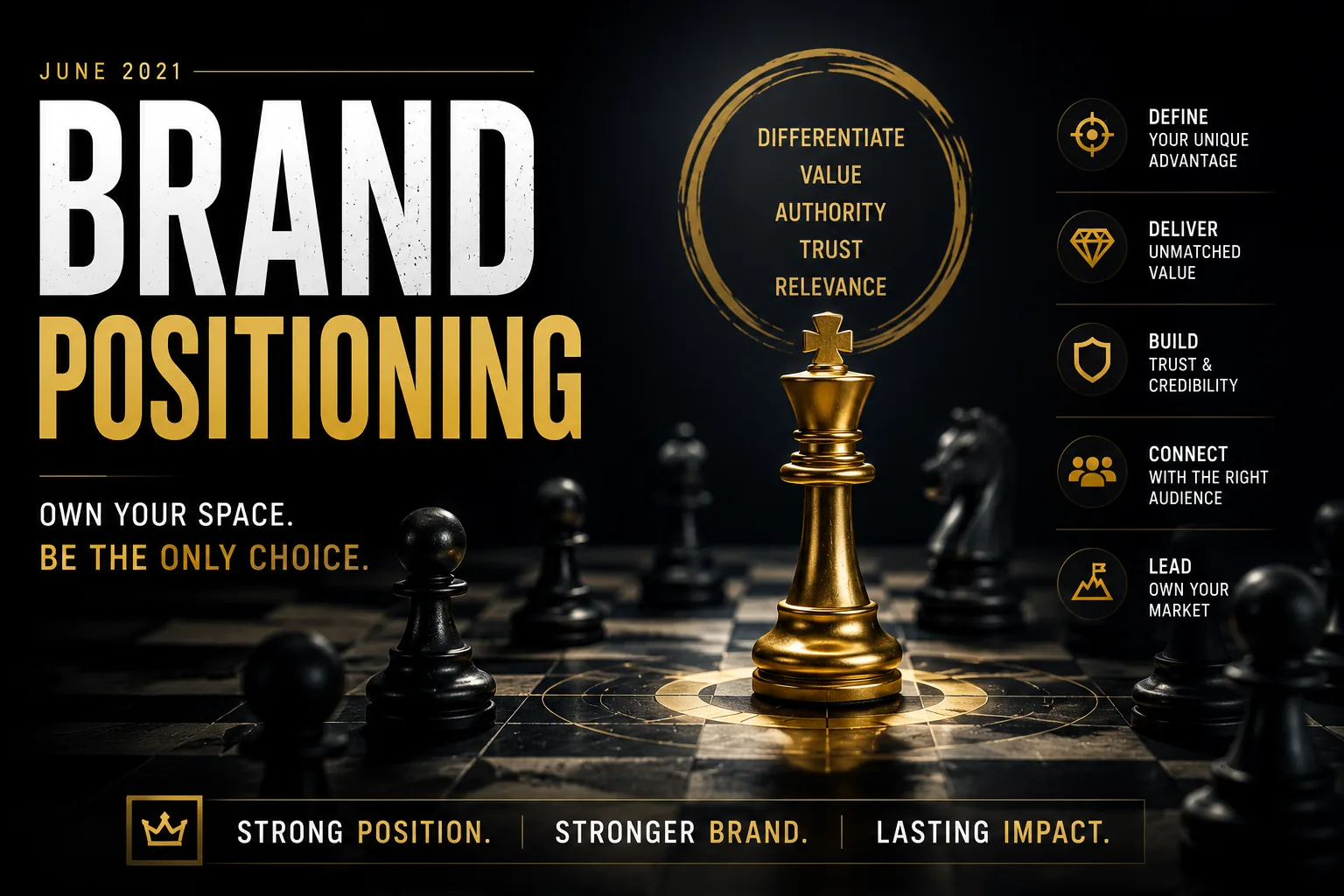
Why Blending In Became Expensive
By June 2021, many businesses had moved online, which made markets feel more crowded. Customers had more options and less patience. A business that looked and sounded like everyone else became easy to ignore.
Brand positioning solved this problem by making the business easier to understand and easier to remember. It clarified who the business helped, what made it different, and why the customer should care.
Positioning Starts With A Clear Audience
A common mistake was trying to appeal to everyone. That usually created bland messaging. Strong positioning begins with a specific audience. The more clearly a business understands who it serves, the easier it becomes to create messaging that feels relevant.
This does not mean excluding everyone else. It means leading with clarity. A clear message attracts the right people faster.
Value Needed To Be Obvious
Customers should not have to search for the reason to choose you. The value should be visible in the headline, service explanation, proof, and call to action. If a visitor has to work too hard to understand the offer, the brand is leaking attention.
Good positioning connects the service to an outcome. Instead of saying digital marketing services, say more qualified leads from search, social, and conversion focused websites. The second version gives the customer something to remember.
Growth gets easier when the message is clear, the system is consistent, and every touchpoint helps the customer take the next step.
Design And Words Had To Match
A polished visual brand with weak messaging felt incomplete. Strong copy with poor design also created friction. The best brands aligned both. The look created attention. The words created meaning.
Consistency mattered across the website, social profiles, proposals, emails, and ads. Every touchpoint either strengthened the brand or weakened it.
The Bottom Line
Brand positioning in 2021 was not just about logos or colours. It was about making the business easier to choose.
The brands that stood out had a clear audience, a clear promise, and a consistent experience. That clarity made every marketing channel work harder.
The Mistake Businesses Kept Making
The most common mistake was treating brand positioning like a task instead of a business system. A task gets checked off and forgotten. A system gets measured, improved, and repeated. That difference matters because growth rarely comes from one isolated action. It comes from a collection of small choices that support each other over time.
For example, a business might publish one strong post, update one page, or run one campaign and then expect the entire market to respond. That is not how digital behaviour works. Customers usually need several signals before they trust a company. They may see a search result, check reviews, visit the website, compare social activity, read a page, and return later before taking action.
This is why brand positioning needed to connect with the rest of the customer journey. The business had to ask what happened before the click, what happened after the click, and what information the customer needed before making a decision. When those pieces were disconnected, growth felt random. When those pieces worked together, results became easier to understand and improve.
How To Make The Strategy Practical
The best approach was to keep the system simple enough to execute. Businesses did not need a complicated marketing department to improve market clarity. They needed a clear rhythm. Review the current position, choose one weak point, improve it, measure the result, and repeat the process monthly.
A practical rhythm could start with a short weekly review. Look at what was published, what was updated, what generated attention, and what created enquiries. Then separate activity from outcomes. Activity is useful only when it moves the business closer to a measurable result. A post that receives likes but sends no qualified traffic may still be useful for awareness, but it should not be mistaken for a conversion asset.
The strongest businesses also documented what worked. They saved high performing headlines, strong offers, common customer questions, useful testimonials, and campaign notes. Over time, that documentation became a playbook. The business no longer had to guess every month. It had a record of what the audience responded to and what helped people move forward.
What To Measure Without Getting Overwhelmed
Measurement does not need to become complicated. The goal is not to track every possible number. The goal is to track the few numbers that help the business make better decisions. For this topic, useful numbers often include direct searches, enquiry quality, proposal close rates, and message recall. Those numbers show whether the strategy is creating attention, trust, and action.
Vanity metrics can still provide context, but they should not control the strategy. A page view, impression, or like is only meaningful when it connects to a larger pattern. If visibility is rising but leads are flat, the message or conversion path may need work. If leads are rising but sales are weak, qualification or follow up may be the issue. If sales are improving but traffic is low, the business may need to scale the channel carefully.
This kind of thinking helped businesses move away from emotional decision making. Instead of saying the campaign feels slow or social media is not working, the team could identify where the system was breaking. That made the next move clearer.
A Simple Thirty Day Improvement Plan
The first week should focus on clarity. Review the main page, profile, campaign, or channel connected to brand positioning. Ask whether a new customer would immediately understand what the business offers, who it helps, and why it is worth trusting. If the answer is no, fix the message before spending more money on traffic.
The second week should focus on proof. Add stronger testimonials, clearer examples, recent photos, helpful content, stronger calls to action, or better explanations. Customers need evidence. Proof reduces hesitation and helps the business look more credible in a crowded market.
The third week should focus on distribution. Once the message and proof are stronger, push the improved asset through the right channels. That might mean search optimization, social posts, email, paid traffic, or internal links from other pages. A strong asset still needs visibility.
The fourth week should focus on measurement. Review what changed. Look at the numbers, but also look at the quality of enquiries and conversations. Better marketing should not only create more activity. It should create more useful activity that helps the business grow with less waste.
Why This Still Matters
The lessons from 2021 still matter because customer expectations have only become sharper. People want faster answers, clearer proof, better design, and more useful content. They compare businesses quickly and reward the ones that make decisions easier.
Brand Positioning is not about chasing a trend. It is about building a stronger path between attention and trust. When that path is clear, marketing becomes less chaotic. The business stops relying on hope and starts improving the pieces that actually influence revenue.
What To Do Next
- Review the strongest page or channel connected to this topic
- Identify one friction point that is costing trust or conversions
- Create one measurable improvement to test this month
- Track the result and repeat what works
Why This Matters More Now
Businesses are competing in a much more crowded search environment than they were even a few years ago. According to Google, people use Search to make billions of decisions every day, and local discovery often begins before a customer ever reaches a website. That means every page, profile, article, review signal, and call to action has to work together. The businesses that win are not always the biggest. They are usually the clearest, most consistent, and easiest to trust.
Depth also matters. Thin content may get published quickly, but it rarely gives search engines or customers enough reason to take the business seriously. A stronger article should answer the real questions a customer is already thinking about: what this means, why it matters, what to do next, and why acting sooner can create an advantage. When content is useful, specific, and connected to real business outcomes, it becomes more than a blog post. It becomes a sales asset that keeps working after the first publish date.
Is Your Brand Message Clear Enough?
We sharpen positioning, website messaging, service language, and visual consistency so your brand is easier to remember and easier to choose.
Sharpen My Brand →